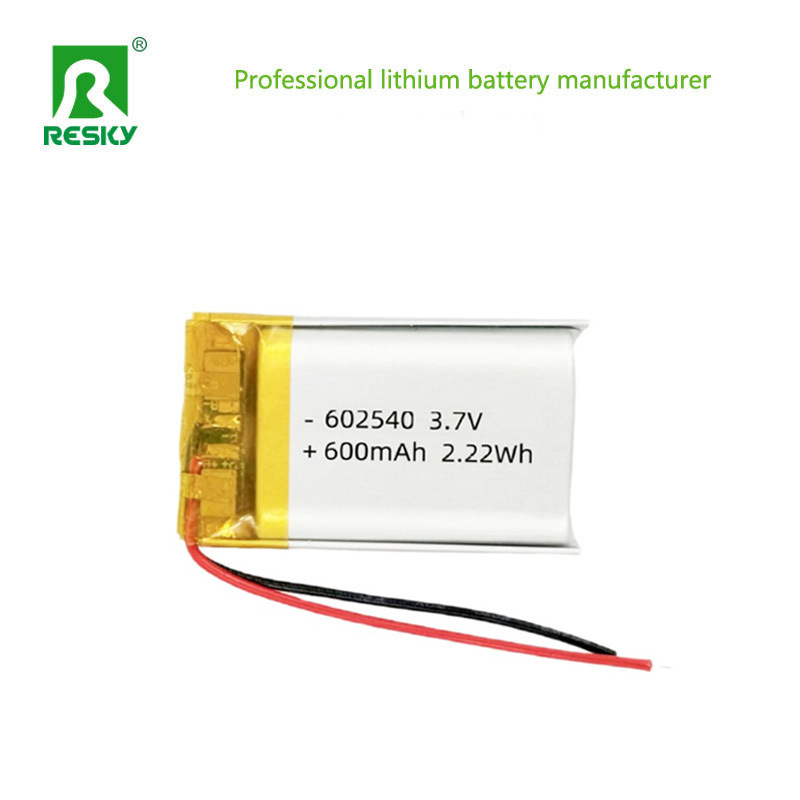
| Brand Name: | RESKY |
| Model Number: | LP602540 |
| MOQ: | 100pcs |
| Price: | Negotiable |
| Packaging Details: | Standard export package |
| Payment Terms: | T/T,Western Union |
| Item | Specification |
|---|---|
| Battery Type | 3.7V 600mAh LiPo battery |
| Charge Voltage | 4.2V |
| Nominal Voltage | 3.7V |
| Nominal Capacity | 600mAh (0.2C Discharge) |
| Charge Current | Standard: 0.5C Rapid: 1.0C |
| Standard Charging Method | 0.5C CC charge to 4.2V, then CV charge till current ≤0.05C |
| Charging Time | Standard: 2.75 hours Rapid: 2 hours |
| Max. Charge Current | 1.0C |
| Max. Discharge Current | 1.0C |
| Discharge Cut-off Voltage | 2.75V (0.2C) |
| Operating Temperature | Charging: 0°C ~45°C Discharging: 0°C ~45°C |
| Storage Temperature | -10°C ~ +45°C |
| Dimensions | Length: 40±2mm Width: 25±0.5mm Thickness: 6±0.2mm |
| Drop Test | 1m drop onto concrete twice - no fire, no leakage |
| Cycle Life | ≥500 cycles |
The cathode material (such as NCM) in ternary lithium polymer batteries, when heated above 200°C, rapidly releases oxygen and reacts with the electrolyte, causing thermal runaway (fire and explosion). Therefore, it must be used with a BMS (battery management system) (precisely controlling charge and discharge voltage and temperature) and an explosion-proof structure.
The lithium iron phosphate cathode in lithium iron batteries has a stable structure and a decomposition temperature exceeding 500°C. It does not release oxygen during decomposition. Even if punctured, squeezed, or overcharged, it only causes a "bulge," with virtually no fire risk. This makes it the preferred choice for applications with extremely high safety requirements (such as energy storage and low-speed vehicles).
The high energy density of ternary lithium allows it to provide greater capacity within a limited weight/volume. As a result, ternary lithium is widely used in consumer electronics (mobile phones, headphones, laptops) and high-end electric vehicles (which strive for long driving range). Lithium-ion batteries have a low energy density and are more suitable for scenarios that don't demand extreme capacity/range, but rather require a long lifespan and low cost (such as energy storage power stations and low-speed electric vehicles).
Cycle Life: The long cycle life of lithium-ion batteries (over 2,000 cycles) makes them suitable for scenarios with long-term, high-frequency use, such as home energy storage power stations (required for over 10 years) and shared electric vehicles (with an average daily charge and discharge cycle of once, for over 5 years). Ternary lithium batteries, on the other hand, have a shorter cycle life (around 1,000 cycles) and are more suitable for consumer electronics with a 2-3 year replacement cycle.
Low-Temperature Performance: Ternary lithium batteries perform better in cold regions (such as northern winter). When used in electric vehicles, the range degradation of ternary lithium batteries is 20%-30% lower than that of lithium-ion batteries. However, lithium-ion batteries require additional heating elements for low-temperature applications, which increases cost and size. Therefore, they are more suitable for warmer regions or indoor applications (such as indoor energy storage).
Overall Rating
Rating Snapshot
The following is the distribution of all ratingsAll Reviews